


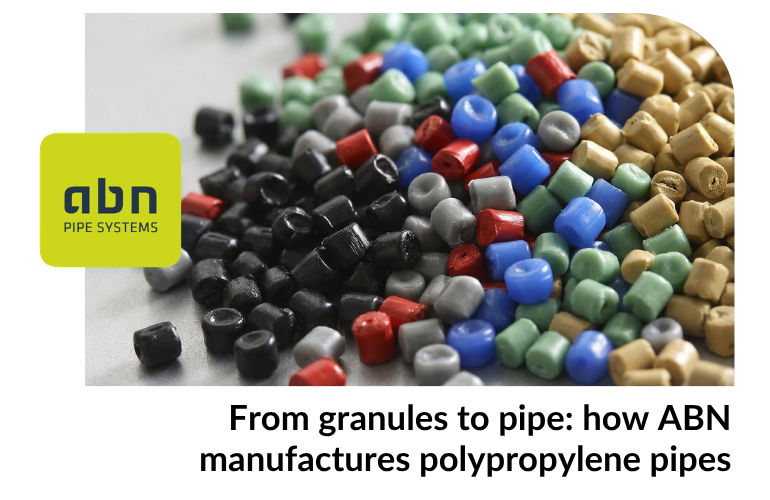
Polypropylene pipe manufacturing starts before a pipe takes shape. At ABN, we prepare our own compound, the formulated material that feeds the extrusion line. From formulation to final cutting, the process takes place at our Medina del Campo facilities in Spain.
Controlling these stages connects the starting material, manufacturing settings and finished-product checks. For installers, this continuity makes it easier to identify the system they are using and obtain technical information.
In this article
- 1. Polypropylene pipe manufacturing starts with the compound
- 2. Extrusion: turning granules into a continuous pipe
- 3. Cooling and dimensional checks
- 4. Marking, cutting and batch checks
- 5. In-house manufacturing and technical support
- 6. Connecting the manufacturing process to pipe selection
- 7. Checks when the material reaches the site
- Frequently asked questions
1. Polypropylene pipe manufacturing starts with the compound
A compound is the formulation used to manufacture a product range. Rather than simply processing a ready-made blend, ABN carries out this stage using its own formulations and equipment.
The composition is defined for the intended use of each system. Keeping this stage in-house supports material review and batch consistency. It does not mean that different ranges necessarily use the same formulation.
2. Extrusion: turning granules into a continuous pipe
Granules enter through the hopper and reach the extruder, where they melt under controlled conditions. The material then passes through the die that forms the pipe.
This is a continuous process. The resulting section must match the dimensions of the product being manufactured, so line settings and checks are part of the same operation.
3. Cooling and dimensional checks
After extrusion, the pipe passes through the cooling stage to stabilise its shape and retain the required dimensions.
Pipe dimensions are checked during the process. Diameter and wall thickness matter both for product identification and for selecting the appropriate fittings and joining procedure.
4. Marking, cutting and batch checks
Before identification and palletising, the pipe goes through these operations:
- Pipe marking.
- Cutting to the required length.
- Preparation for identification and palletising.
Marking helps professionals recognise the supplied product and consult the relevant documentation.
Batch checks take place before supply. Performance and permitted applications should be checked in the specific product data sheet: using the same base polymer does not make every pipe suitable for the same conditions.
5. In-house manufacturing and technical support
Manufacturing in Medina del Campo allows questions about materials and production to be addressed by the manufacturer. When a project needs a particular solution, the assessment should start with its operating conditions.
Find out more about ABN and its manufacturing or explore our pre-insulated piping solutions.
6. Connecting the manufacturing process to pipe selection
Understanding polypropylene pipe manufacturing helps you frame a technical enquiry, but selection starts with the installation. A water circuit and a line carrying a different fluid may require different product ranges. The data sheet for the selected product is the reference for checking its intended use; the material name alone does not settle that decision.
Before comparing options, record the fluid, operating temperature and pressure, and proposed route. Include the pipe sizes, equipment connections and any space restrictions. These details allow the complete solution to be reviewed, including fittings and joining methods, rather than assessing a straight length of pipe in isolation. They also give the designer and installer a common starting point.
7. Checks when the material reaches the site
Check that the supplied product identification matches the range and dimensions on the order. Retain the markings and documentation needed to identify it, particularly when similar-looking pipes are stored together. This makes it easier to resolve a question before cutting or installation, while the product can still be identified clearly.
For example, if a design revision changes a pipe diameter, review the corresponding fittings and joining procedure too. The connection between manufacturing, identification and installation is useful when each decision refers to the actual product. Use the ABN data sheets and installation manuals to prepare that check and keep the documentation with the installation information.
Frequently asked questions
Tell us what your installation needs
ABN Pipe Systems manufactures in Spain and provides technical support from the design stage. Send us your operating conditions and project details so we can assess the solution.
Call +34 981 148 425 or email info@grupoabn.com.
