

Polypropylene PPR fire protection pipes
Discover the characteristics, applications and advantages of ABN fire protection systems in PPR polypropylene, the material of the future for your construction projects.

Piping, sprinklers and fire hydrants (BIEs) are the main elements of a fire fighting system, and it is vital to choose the most innovative and adaptable parts for each situation.
Until recently, the most common materials for fire protection networks were metallic options such as galvanised steel or stainless steel, but today we have new certified plastic systems that offer better solutions thanks to their technical particularities for fire protection networks, becoming a safe and reliable material as an alternative to steel in sprinkler systems (sprinkles) and BIEs.


 20-200 mm





Characteristics of PPR polypropylene pipes
- PPR pipes do not melt in case of fire. PPR CT pipes are classified B, s1 – d0, according to the European standard en 13501, which guarantees that it is a non-combustible material, with very low smoke emission and no dripping.
- In addition, to ensure that they will withstand fire, these systems are double-checked for fire performance. On the one hand, they have reaction to fire tests for construction products and on the other hand, they have fire exposure tests, both accredited by AENOR.
- PPR pipes are an improved version of steel pipes. Corrosion in sprinkler systems at PCI is, on the one hand, 60% of the generalised type (oxidation), and 40% due to microbiological influence (MIC). Compared to steel, PPR pipes have a much lower roughness coefficient, which means that they do not corrode over time.
- Las tuberías en PPR están homologadas para su instalación en redes contraincendios. Las tuberías en PPR están certificadas por AENOR y homologadas por el RIPCI para uso de BIEs y rociadores para los siguientes riesgos:
- Sprinklers, in light risk (LR) and ordinary risk (OR) areas
- BIEs, in low risk (RB) and medium risk (MR) areas for standardised 25 and 45 mm hoses
- PPR pipes are economic. The handling of PPR pipes is made much simpler by using hot melt as the joining system, ensuring a quicker and cleaner installation. Therefore, in addition to the aforementioned advantages that make PPR pipes reduce maintenance costs, it also means a reduction in installation costs as it does not require auxiliary resources.
- Plastic pipes are recyclable. Contrary to many beliefs, PPR pipes are environmentally friendly and recyclable, making polypropylene a suitable material for sustainable construction.
The 7 advantages of PPR systems in fire protection networks
This type of pipe guarantees advantages in situations where prevention is of little importance, such as in the event of fire, as well as having a service life of more than 50 years. Their installation is recommended, for example, in administrative and educational buildings, residential buildings, hospitals, public spaces with large numbers of people and car parks.
Here’s why you should use polypropylene pipes in fire fighting systems:
- Corrosion resistance. This material prevents the corrosion of the pipes inside them, reducing the obstructions that prevent sufficient water flow and, in addition, they do not require continuous maintenance.
- Lightweight. In contrast to metal pipes, PPR pipes have a much higher degree of lightness.
- Reduction of operating costs of the installation. The assembly of these pipes is carried out by thermofusion welding, which results in a reduction of assembly times and, consequently, installation costs are reduced.
- Homogenisation. When assembled, the pipe and fitting are fused together to form a much more uniform fit, avoiding any mechanical positioning thanks to the use of hot melt welding.
- Stability. Thanks to this homogenization, a highly stable joint is achieved through the fusion of the seat with the outer surface and thickness of the pipe. This technique is used for the execution of cuttings, derivations and sprinkler connections.
- Versatility. They have the virtue of being able to adapt to the different situations to which they are subjected easily and quickly, being very tolerable in the face of change.
- Durability. These pipes have been designed, tested and certified to guarantee a useful life of more than 50 years, without requiring any type of subsequent maintenance.
Applications of polypropylene pipes for firefighting systems
For all these reasons, PPR pipes are positioned as an alternative to provide a solution to other problems caused by metallic sprinkler pipes, such as:
- Leaks from perforations
- Frequent system shutdowns
- Production losses
- Total system replacements
- Reduced design efficiency
ABN Pipe Systems’ PPR polypropylene fire protection piping systems
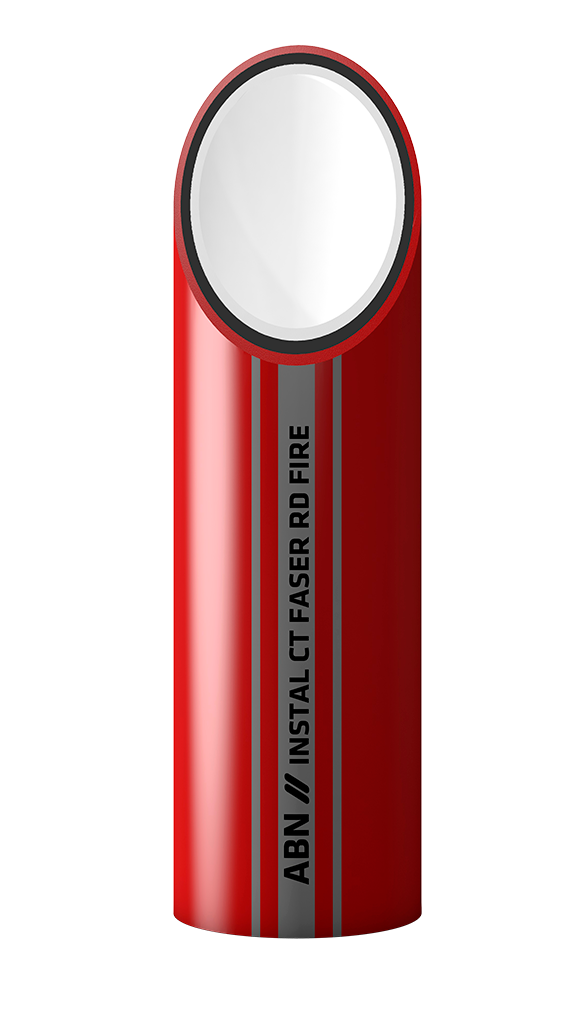


Fire resistance
The reaction to fire classification B-s1,d0 is a European specification describing the fire performance of building materials according to EN 13501-1:2019. Classification according to the fire performance of construction products and building elements. Part 1: Classification based on data obtained from reaction to fire tests.
This classification is divided into several parts that indicate:
- B: Refers to the classification of the material in terms of its reaction to fire, where “A” indicates non-combustible materials and “B” refers to materials with very limited contribution to fire. In this case, “B” means that the material (in this context, PPR pipes) has a very good fire performance, with limited combustibility.
- s1: Indicates smoke production during combustion. “s1” means that the material produces little smoke when burning, which is important for visibility and toxicity in case of fire.
- d0: Refers to the production of flaming droplets or flaming particles while the material is burning. “d0” means that the material does not produce flaming droplets, which is crucial to prevent the spread of fire through the fall of ignited particles.
Polypropylene pipes complying with the B-s1,d0 classification are, therefore, materials with a very favorable reaction to fire, ideal for applications where fire safety is a priority. Their ability to limit smoke generation and prevent the production of flaming droplets or particles helps to minimize the risks associated with the evacuation of people and the spread of fire.
Joining techniques: types of welding for PPR pipes
The joining methods for this type of pipe are based on thermofusion, applying techniques such as polyfusion, electrofusion, and butt welding, each with its own specific method. This process ensures efficient installation and significantly reduces installation time, guaranteeing the integrity of the system thanks to the molecular fusion of the polypropylene. In addition, preparation for post-welding operation is faster compared to other materials, with electrofusion and butt welding for specific situations and large diameters.
Electrofusion welding
It is based on accessories to which a copper spiral is incorporated in the manufacturing process. By means of connectors, a voltage of between 8 and 48 volts is introduced so that, by means of the joule effect, it heats up and transfers this heat to the tube that we have previously inserted, to form the union between the tube and the accessory. This technique can be used for joining pipes with diameters from 20 to 160 mm.
Socket welding
It consists of heating the external surface of the pipe and the internal surface of the fitting, until it reaches the melting of the material, and then fitting the pipe inside the fitting while the material is hot. This technique is used for joining polypropylene pipe systems with diameters from 20 to 160 mm.
Welding ABN//WELDING ELECPIPE
It is a new joining system, different from the traditional one, with electrofusion incorporated in the pipe, which allows the pre-assembly of the installations before the joint is made, since the copper loop is incorporated in the pipe. The ABN//WELDING ELECPIPE technology also has the advantage of being a fast method that does not require auxiliary means to make the joint, with the consequent reduction in costs, as the clamps ensure pre-assembly before welding, providing a secure and durable joint.