

PPR polypropylene pipes
Learn about the technical characteristics, applications and advantages of PPR polypropylene, demonstrating why this material is the future choice for construction projects. From its application in residential systems to its role in industrial environments, PPR has marked a before and after in the sector.
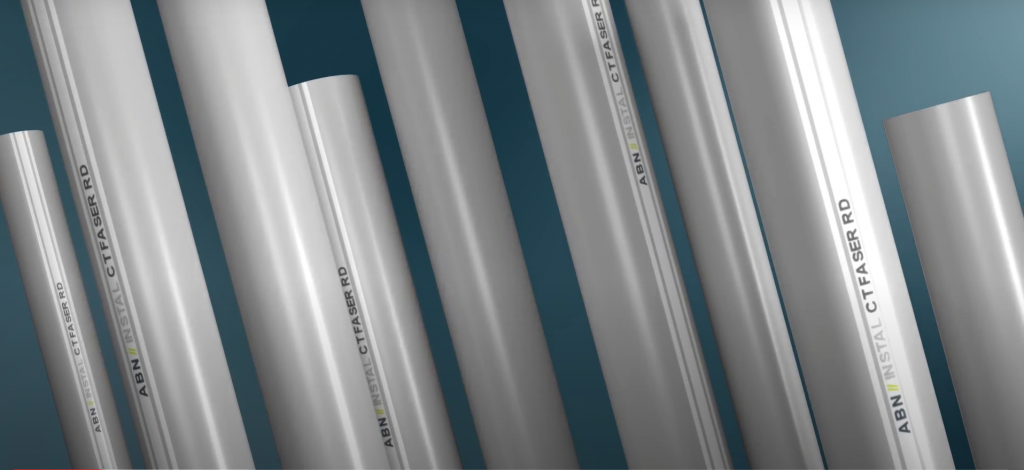
Polypropylene Random (PPR) is a highly versatile and durable type of thermoplastic plastic. This material, known for its resistance to high temperatures and pressures, has become the preferred choice for modern plumbing systems.
PPR’s unique molecular structure, which includes randomly arranged polypropylene chains, gives it exceptional impact resistance and long service life. Its resistance to corrosion and the accumulation of mineral deposits ensures the purity of the water conveyed, making PPR an ideal choice for potable water pipelines, heating systems and compressed air networks.
In addition, the ease of installation by means of thermofusion, which creates hermetic and safe joints, makes it preferred by professionals.
Characteristics of PPR polypropylene pipes
PP-R polypropylene pipes stand out for their 100% corrosion resistance, lower surface roughness, and low heat transmission capacity, which limits thermal dispersion and condensation. They offer absorption and acoustic insulation, high resistance to chemical agents, and reduced installation times thanks to their efficient joining systems. These characteristics make them ideal for a wide range of applications, ensuring durability and efficiency in plumbing and heating systems.
ABN Pipe Systems’ PPR polypropylene piping systems
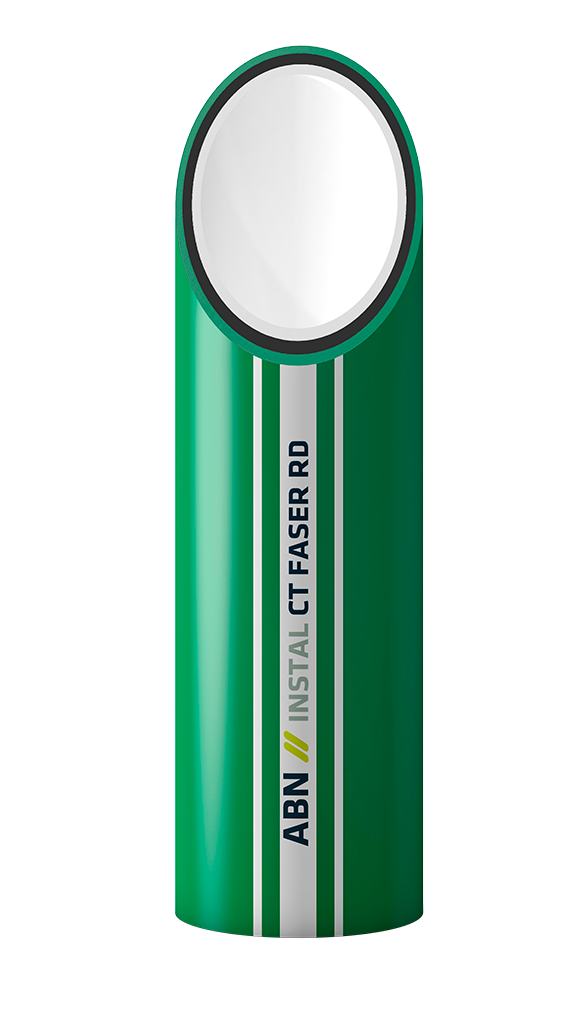
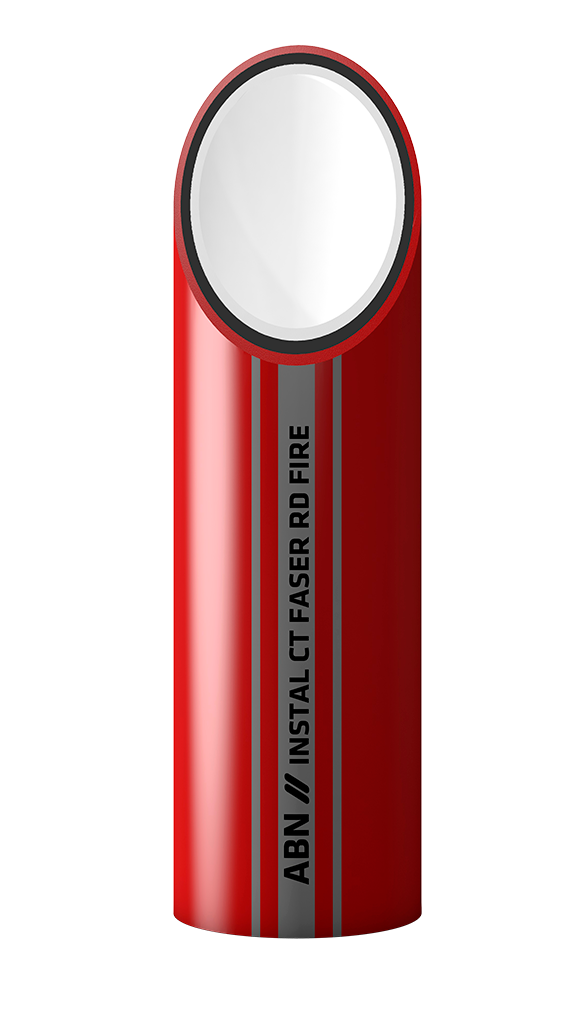
Corrosion resistance
PPR polypropylene pipes offer exceptional corrosion resistance, making them ideal for plumbing and heating system applications. This property ensures superior durability and longevity against chemical and electrochemical corrosion, common in metallic pipes.
The corrosion of pipes depends mainly on the environment in which they are placed, the material of their manufacture and the operating regime to which they are subjected, being the external protection of the pipe the one that must be studied with greater care, due to the fact that the surrounding environment is more aggressive than the water circulating inside.
The properties of ABN//INSTAL CT Faser RD PPR pipes are not altered in the presence of limes, plasters and cement mortars. This means that no surface protection is required. Neither do they present problems of rotting, rust, mildew or oxidation, nor are they affected by algae, bacteria or fungi.
The choice of PPR polypropylene pipe is synonymous with an investment in efficiency and long-term reliability.
Reduced surface roughness
PPR polypropylene pipes have a distinctive design feature: an internal surface with significantly reduced roughness. This technical feature facilitates an optimized laminar flow regime, minimizing head losses and improving hydraulic efficiency. The precision manufacturing of these pipes ensures uniformity inside, which is crucial to prevent the deposition of debris and the proliferation of microorganisms.
This lower roughness also contributes to a reduced energy requirement for pumping fluids, which translates into lower operating costs and a positive environmental impact by reducing energy consumption. This technical advantage not only improves the long-term performance of plumbing and heating installations but also promotes greater sustainability of fluid handling systems.
To maximize the efficiency and performance of PPR polypropylene pipes, noted for their low internal surface roughness, ABN has developed an advanced tool for head loss calculation. This tool is indispensable for plumbing professionals, as it allows for accurate estimates of head losses in plumbing and heating systems, thus ensuring design optimization and energy efficiency in project execution.
Roughness coefficients
ABSOLUTE ROUGHNESS
| MATERIAL | ε(mm) |
|---|---|
| PE, PVC, PPR | 0,0015 |
| GLASS FIBRE REINFORCED POLYESTER | 0,01 |
| STEEL KNURLED TUBE | 0,0024 |
| COPPER PIPES | 0,0015 |
| CEMENT-LINED FOUNDRY IRON | 0,0024 |
| BITUMINOUS COATED FOUNDRY IRON | 0,0024 |
| CENTRIFUGAL FOUNDRY | 0,003 |
| GALVANISED IRON | 0,06-0,24 |
MANNING’S COEFFICIENT
| MATERIAL | n |
|---|---|
| PE, PVC, PPR | 0,006-0,010 |
| GLASS FIBRE REINFORCED POLYESTER | 0,009 |
| IRON | 0,010-0,011 |
| GALVANISED IRON | 0,015-0,017 |
| FOUNDRY | 0,012-0,015 |
| CONCRETE | 0,012-0,017 |
| CONCRETE COATED WITH GUNITE | 0,016-0,022 |
BITUMINOUS COATING | 0,013-0,016 |
ROUGHNESS COEFFICIENT HAZEN – WILLIAMS
| MATERIAL | ε(C) |
|---|---|
| GALVANISED IRON | 0,0015 |
| FOUNDRY IRON | 0,01 |
| PE, PVC, PPR | 0,0024 |
| IRON | 0,0015 |
| CONCRETE | 0,0024 |
| COPPER | 0,0024 |
| DUCTILE FOUNDRY | 0,003 |
Acoustic insulation
PPR polypropylene pipes offer excellent acoustic insulation, significantly reducing the noise produced by water flow. This feature makes them an ideal choice for installations in residential and commercial buildings where noise minimization is a priority. The polypropylene material helps absorb vibrations and decrease sound transmission, ensuring a quieter and more comfortable environment.
The sound-absorption and elasticity of the ABN//INSTAL CT Faser RD system prevents the propagation of noise and vibrations from water flow and water hammer, thus achieving a very high degree of acoustic insulation.
Thus, noise transmission is much lower compared to metallic pipes, allowing for higher water flow velocities.
Low heat transfer capacity
PPR polypropylene pipes are characterized by their low heat transfer capacity, a property that makes them exceptionally suitable for heating and hot water systems. This feature minimizes heat losses, increasing energy efficiency and reducing operating costs. In addition, it helps maintain a constant temperature of the transported water, contributing to superior thermal performance compared to other materials.
Thermal insulation ABN// INSTAL CT Faser
The thickness of the insulation of the pipes, both in the flow and in the return, will be sized according to what is indicated in the Regulation of Thermal Installations in Buildings (RITE), approved in the Royal Decree 1027/2007, of July 2 and updated in April 2013 in its technical instruction IT 1.2.4.2.2.1, the conditions in which the pipe networks in the cold and hot water installations must be insulated.
IT 1.2.4.2.1.1.1
All pipes and fittings as well as equipment, appliances and tanks of thermal installations shall be provided with thermal insulation where they contain thermal insulation:
- Refrigerated fluids with a temperature lower than the ambient temperature of the room through which they flow.
- Fluids with temperature higher than 40 ºC when installed in unheated premises.
Minimum insulation thicknesses (mm) of cooling circuits for air conditioning* depending on the pipe routing.
| Outside diameter (mm) | Inside buildings (mm) | Outside buildings (mm) |
|---|---|---|
| D≤ 13 | 1 | 15 |
| 13 | 15 | 20 |
| 26 | 20 | 25 |
| 35 | 30 | 40 |
| D>90 | 40 | 52 |
If the external route of the pipe is greater than 25 m, these thicknesses must be increased to the next higher commercial thickness, with an increase in no case less than 5 mm.
Simplified Procedure IT 1.2.4.2.2.1.2
The simplified procedure establishes the minimum thermal insulation thicknesses, in mm, for a reference insulation material at 10 ºC of 0.040 W/(m.K) should be as indicated in the following tables:
HOT fluids inside buildings
| Outside diameter (mm) | Max. fluid temperature 40-60 ºC | Max. fluid temperature >60-100 ºC | Max. fluid temperature >100-180 ºC |
|---|---|---|---|
| D≤ 13 | 25 | 25 | 30 |
| 35 | 30 | 30 | 40 |
| 60 | 30 | 30 | 40 |
| 90 | 30 | 40 | 50 |
| 140< D | 35 | 40 | 50 |
HOT fluids on the EXTERIOR of buildings
| Outside diameter (mm) | Max. fluid temperature 40-60 ºC | Max. fluid temperature >60-100 ºC | Max. fluid temperature >100-180 ºC |
|---|---|---|---|
| D≤ 13 | 35 | 35 | 40 |
| 35 | 40 | 40 | 50 |
| 60 | 40 | 40 | 50 |
| 90 | 40 | 50 | 60 |
| 140< D | 45 | 50 | 60 |
COLD fluids inside buildings
| Outside diameter (mm) | Max. fluid temperature >-10-0 ºC | Max. fluid temperature >0-10 ºC | Max. fluid temperature >10 ºC |
|---|---|---|---|
| D≤ 13 | 30 | 25 | 20 |
| 35 | 40 | 30 | 20 |
| 60 | 40 | 30 | 30 |
| 90 | 50 | 40 | 30 |
| 140< D | 50 | 40 | 30 |
COLD fluids on the EXTERIOR of buildings
| Outside diameter (mm) | Max. fluid temperature >-10-0 ºC | Max. fluid temperature >0-10 ºC | Max. fluid temperature >10 ºC |
|---|---|---|---|
| D≤ 13 | 50 | 45 | 40 |
| 35 | 60 | 50 | 40 |
| 60 | 60 | 50 | 50 |
| 90 | 70 | 60 | 50 |
| 140< D | 70 | 60 | 50 |
Chemical resistance
PPR polypropylene pipes are distinguished by their outstanding chemical resistance, which makes them compatible with a wide variety of liquids and prevents degradation by chemicals. This feature is crucial for industrial and residential applications where chemical exposure is common. For a detailed evaluation of the chemical compatibility of your pipes, ABN offers the PipeCloud chemical resistance tool, facilitating the proper selection of pipes for each specific project.
As ABN//INSTAL CT Faser RD pipes are made of high molecular weight polyolefins, they have a non-polar structure, which gives them excellent resistance to chemical agents.
Thanks to their chemical inertness, they are resistant to inorganic acids (hydrochloric, sulfuric, etc.), alkalis, detergents, mineral oils or fermentation products.
They are not altered by seawater, saline or acidic soils, or by urban or industrial discharges.
ABN//INSTAL CT Faser RD is more resistant to the possible aggression of hard water and withstands chemicals with a pH value between 1 and 14, which includes acidic and alkaline substances, as well as chlorine, fluoride or iron contained in the water.
Reduced installation times
The connection methods used by ABN products focus on thermofusion, applying techniques such as polyfusion, electrofusion, and butt welding, each with its own specific method. This process ensures efficient installation and significantly reduces installation time, guaranteeing the integrity of the system thanks to the molecular fusion of the polypropylene. In addition, preparation for post-welding operation is faster compared to other materials, with electrofusion and butt welding for specific situations and large diameters.
PPR polypropylene pipes with oxygen barrier
PPR polypropylene pipes with oxygen barrier are designed to offer superior protection against oxygen penetration. This feature is essential in hot water heating systems, where the presence of oxygen can cause corrosion of metal components. The oxygen barrier increases system life and maintains operating efficiency, ensuring a durable and reliable solution for heating and cooling installations.
Incorporating an oxygen barrier, these PPR polypropylene pipes prevent internal system oxidation, crucial for applications involving hot water and central heating. This technological innovation not only protects against corrosion but also improves water quality and system efficiency, offering a comprehensive and advanced solution for fluid handling in residential and commercial environments.
Benefits of oxygen barrier in PPR pipe
The incorporation of an oxygen barrier in PPR pipe presents a number of significant benefits for plumbing and heating systems. This technological innovation prevents corrosion of metallic components and reduces the risk of bacterial growth within pipes, ensuring greater system longevity and efficiency. In addition, by preventing oxygen ingress, material degradation is minimized and the quality of the water conveyed is maintained, which is crucial for both residential and industrial applications. This advance represents a step forward in the optimization of plumbing installations, combining durability with environmental protection.
Breakdowns or failures in water-based installations are caused by various factors that are well known to professionals in the sector.

Oxidation of components

Sludge formation (magnetite)

Biofilm formation
Current problems with oxygen barrier systems
Current systems with an anti-oxygen barrier using EVOH or aluminium have the following problems:

In PPR systems it is necessary to remove the barrier layer for welding.

The product is no longer recyclable and sustainable.
The oxygen barrier of ABN’s PPR pipes
Our oxygen impermeable pipe systems maintain recyclability and sustainability by not including additional layers.

It is not necessary to carry out layer removal processes for welding.

The product maintains its recyclability and sustainability.
ABN Polypropylene Piping Systems
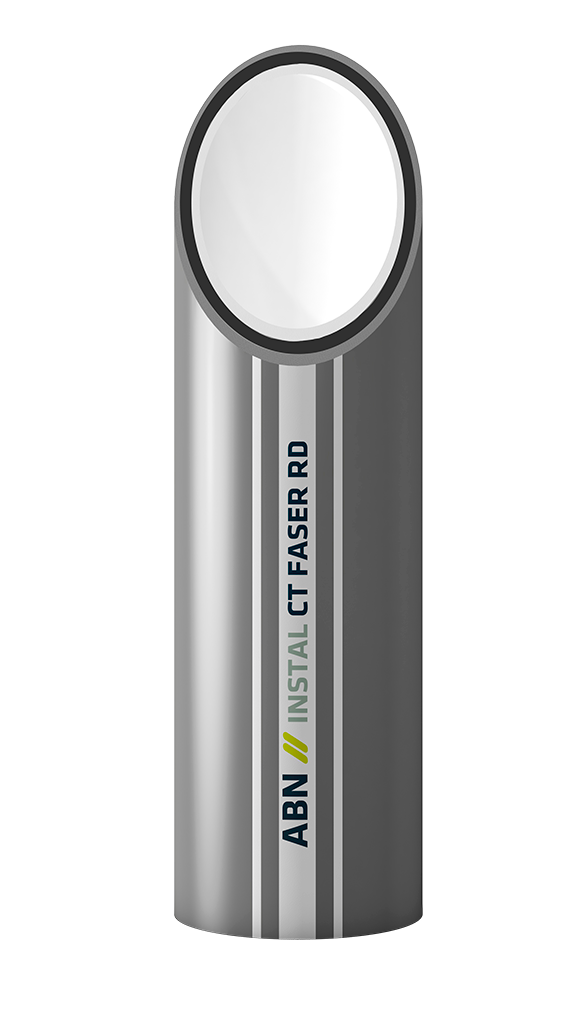
Piping systems for 3-layer PPR CT RP polypropylene piping systems. Halogen free and with oxygen barrier. Eco-designed for a circular economy and sustainable construction buildings.
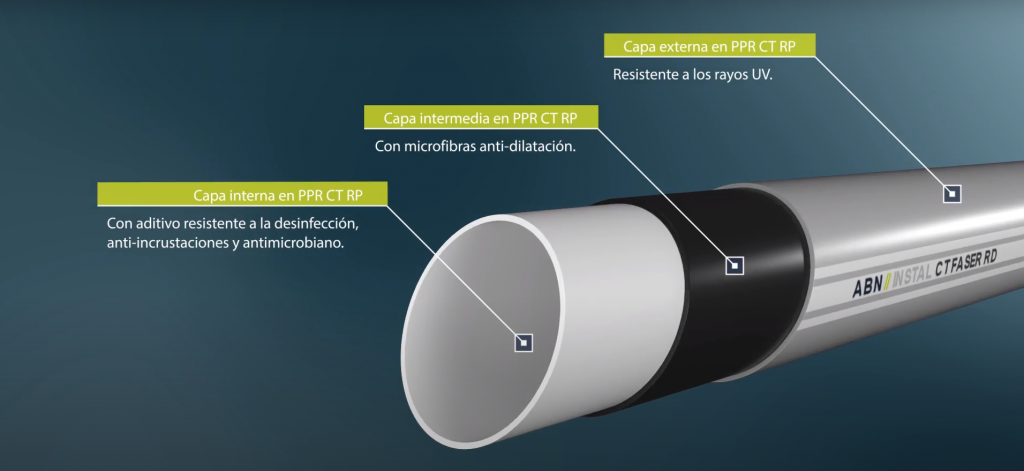
- RAL 9006 silver outer layer with white RAL 9003 bands in PPR CT RP, UV resistant.
- Intermediate layer in gray RAL 7042 in PPR CT RP with anti-dilatation microfibers.
- RAL 9003 white inner layer in PPR CT RP with disinfection-resistant, anti-fouling and anti-microbial additive.
Climate and heating
Advantages of ABN’s PPR polypropylene pipes
- High thermal and mechanical resistance: PPR CT effectively withstands extreme temperatures and high pressures, making it ideal for advanced heating and cooling systems.
- Durability: This material is resistant to corrosion, scaling and chemical degradation, which significantly extends the useful life of the pipes.
- Efficient installation: Thanks to its light weight and hot-melt technique, PPR CT allows for fast and efficient installation, reducing labor costs and implementation time.
- High flexibility and lightness: The malleability of PPR CT allows bends and connections without complications, facilitating its adaptability to different projects.
- Sanitary safety: It is a safe material for the transport of drinking water, since it does not alter its quality or favor contamination.
- Energy efficiency: Its thermal insulation is superior, minimizing heat loss in hot water systems, which translates into significant energy savings.
- Eco-friendly: PPR CT is recyclable, supporting sustainable and environmentally friendly construction practices.
- Noise reduction: Offers lower sound transmission compared to metallic pipes, improving acoustic comfort in installations.
- Low coefficient of expansion: PPR CT exhibits lower expansion and contraction with temperature changes, ensuring greater stability and longevity of the piping system.
- Abrasion Resistance: It is resistant to physical damage, making it suitable for demanding construction environments.
- Chemical Compatibility: Its resistance to a variety of chemicals makes it suitable for use in the chemical industry and in environments with corrosive substances.
- Cost-effectiveness: Despite its advanced technology and benefits, PPR CT offers a long-term cost-effective solution due to its durability and efficiency.
Polypropylene pipe applications
Polypropylene Random (PPR), due to its versatility and resistance, has become a widely used material in various sectors. Here we present an analysis of its multiple applications:
- Residential and commercial plumbing systems: PPR is widely used in hot and cold water piping in residential and commercial buildings due to its corrosion resistance and durability.
- Heating and air conditioning networks: Its ability to withstand high temperatures makes it ideal for heating systems, including underfloor heating and radiators.
- Chemical and pharmaceutical industry: The chemical resistance of PPR makes it a safe choice for the transport of liquids and gases in these industries.
- Compressed air systems: Its resistance to pressure and abrasion makes it suitable for compressed air systems in industrial environments.
- Agriculture and irrigation: It is used in irrigation systems due to its resistance to solar exposure and chemicals used in agriculture.
- Water treatment facilities: In water treatment plants, PPR is used for its corrosion resistance and hygienic properties.
- Industrial refrigeration systems: Its ability to handle low temperatures makes it useful in industrial refrigeration and freezing systems.