


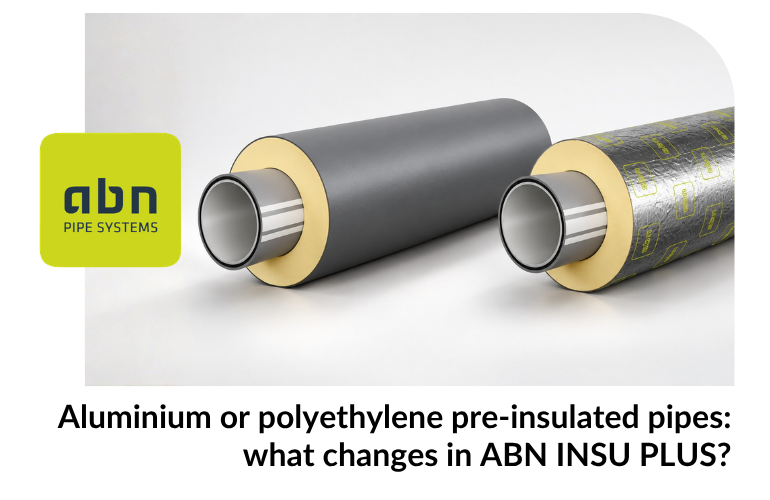
When comparing aluminium or polyethylene pre-insulated pipes, the most visible difference is the external protection. In the ABN INSU PLUS variants described here, the carrier pipe and insulation retain the same functions; the jacket is selected to suit the environment and project requirements.
The decision should consider location, exposure and the performance of the specific configuration. Appearance alone is not enough to specify the system.
In this article
- 1. Aluminium or polyethylene pre-insulated pipes: shared layers
- 2. Aluminium: an option for indoor installations
- 3. Polyethylene: protection for outdoor and buried routes
- 4. Information needed to choose a variant
- 5. Work that remains during installation
- 6. Choose the jacket for each part of the route
- 7. Compare the complete supply and the remaining finishing work
- Frequently asked questions
1. Aluminium or polyethylene pre-insulated pipes: shared layers
Both solutions use a carrier pipe from the PP-RCT family and factory-applied insulation. External protection completes the supplied assembly.
The design must be checked against the product range, diameter and operating conditions. Sharing a construction concept does not mean that every performance characteristic is identical.
2. Aluminium: an option for indoor installations
The aluminium-jacketed variant is intended for indoor applications. It can be considered for plant rooms, service shafts or internal routes where the reaction-to-fire requirements of the complete system must be checked.
Classification applies to the tested system and configuration, rather than to aluminium in isolation. Consult the ABN PPR CT INSU-AL data sheet and the documentation applicable to the project.
3. Polyethylene: protection for outdoor and buried routes
According to its data sheet, the PE-jacketed variant is intended for indoor, outdoor and buried locations. Protection against the environment must be assessed alongside the route and installation details.
Technical roofs and buried networks also require defined supports, interfaces and installation conditions. Consult the ABN PPR CT INSU-PE data sheet and the guide to the polyethylene jacket.
4. Information needed to choose a variant
To select a variant, specify:
- The pipe location.
- The fluid and operating pressure and temperature.
- Exposure conditions.
- Reaction-to-fire requirements.
- Maintenance or access restrictions.
Also check which fittings and jointing solutions belong to each variant. Jacket selection should be part of specifying the complete system.
5. Work that remains during installation
Factory insulation reduces operations that would otherwise be carried out on the supplied components on site. However, joints and finishing must still follow the system’s installation procedure.
Insulation and protection continuity must also be completed at specific interfaces. Planning these details is as important as selecting the jacket material.
6. Choose the jacket for each part of the route
One project can include an internal plant room, a rooftop section and a buried route. Before choosing aluminium or polyethylene pre-insulated pipes, separate these locations and identify the conditions affecting each one. Adjacent sections do not necessarily have the same exposure or call for the same external protection.
For indoor sections, review the aluminium variant alongside the requirements for the complete system. For outdoor or buried routes, check the polyethylene-jacketed solution and the conditions in its data sheet. Where the location changes along the network, ask how to detail the transition and the interfaces. The visible jacket alone does not define how those connections should be completed.
7. Compare the complete supply and the remaining finishing work
A useful comparison includes pipe lengths, fittings and the operations left for installation. Ask the proposal to identify the variant of each component and explain how insulation continuity will be maintained at joints. This helps establish whether the quotation covers the actual route, rather than just a total number of metres.
Also consider access for handling the components and inspecting the connection points after assembly. The external finish helps identify a variant, but documentation and project conditions determine its selection. If details remain unresolved, send a route drawing showing each location and the operating conditions so that the proposed configuration can be reviewed before ordering.
Frequently asked questions
Choose your INSU PLUS variant with ABN
ABN Pipe Systems manufactures in Spain and provides technical support from the design stage. Send us your operating conditions and project details so we can assess the solution.
Call +34 981 148 425 or email info@grupoabn.com.
