


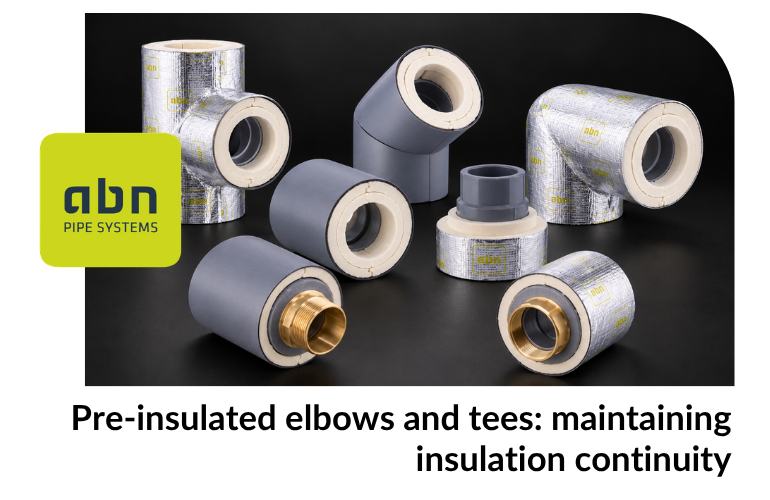
Pre-insulated elbows and tees extend the insulation approach beyond straight pipe sections. At bends and branches, insulation layers must accommodate the fitting geometry and its interfaces with the pipe.
ABN INSU PLUS includes fittings supplied with factory-applied insulation. To make the most of this solution, define the complete range of components and the installation procedure before work starts on site.
In this article
- 1. Pre-insulated elbows and tees at bends and branches
- 2. What factory insulation contributes
- 3. Review the fittings required
- 4. Select the applicable joining method
- 5. Check continuity before closing the installation
- 6. Turn the route drawing into a fitting schedule
- 7. Review the network before access becomes restricted
- Frequently asked questions
1. Pre-insulated elbows and tees at bends and branches
Insulating a straight section and insulating an elbow are different operations. Fittings introduce changes of direction, multiple outlets and interfaces that need specific finishing details.
If these areas are not included when planning the supply, some adaptation work is left for the site team. Identifying every fitting on the drawing helps anticipate those tasks.
2. What factory insulation contributes
A pre-insulated fitting arrives with insulation designed for its geometry. This helps organise the supply and reduces the work needed to shape insulation around the fitting on site.
Continuity across the complete network still depends on installation. Joints and finishing details must be completed so insulation and protection perform their functions along the route.
3. Review the fittings required
The supply should include the elbows, tees, branches and other parts required by the project. Unions, valves and installation kits should also be assessed within the agreed configuration.
Confirm references, diameters and compatibility with the selected aluminium or polyethylene variant. Do not assume that any combination of components belongs to the same system.
4. Select the applicable joining method
Depending on the range and diameter, socket fusion, butt fusion or electrofusion fittings may be used. Selection must match the components and the manufacturer’s procedure.
Joining the carrier pipe and maintaining insulation continuity are related but distinct tasks. Once the joint is made, complete the insulation and protection solution specified for that location.
5. Check continuity before closing the installation
Before closing the installation, review:
- Changes of direction.
- Branches.
- Transitions.
- Supports.
- Access points.
Check that no interfaces remain unfinished and that maintenance operations are still possible.
Explore our pre-insulated solutions and the guide to thermofusion joining methods to prepare the installation.
6. Turn the route drawing into a fitting schedule
To specify pre-insulated elbows and tees, follow the installation drawing from the equipment outlet to each circuit. Identify changes in direction, branches and equipment connections that require a particular fitting. Then check that schedule against the selected pipe variant and the dimensions shown in the design. This gives the order a clear relationship to the proposed route.
Counting a tee is only the start of defining a branch. Specify the connections to adjacent pipe sections and the space available to assemble them. Apply the same review to bends close to walls or equipment. This makes it easier to identify interfaces that need a finishing detail before the components reach the site, while design decisions can still be coordinated.
7. Review the network before access becomes restricted
Before closing a ceiling void, service shaft or another area with limited access, review the interfaces between components. Check the remaining insulation work, external protection and the ability to inspect connections as required by the design. Resolving these points while the route is accessible makes it easier to address a discontinuity or clarify an installation detail.
Pre-insulated elbows and tees belong to a system that also includes its joints. Confirm the applicable joining procedure and record any specific interfaces completed on site. Assess continuity along the finished route: factory-insulated fittings reduce work on the components themselves, but they do not replace inspection of the connections between them.
Frequently asked questions
Plan the complete fitting schedule with ABN
ABN Pipe Systems manufactures in Spain and provides technical support from the design stage. Send us your operating conditions and project details so we can assess the solution.
Call +34 981 148 425 or email info@grupoabn.com.
