


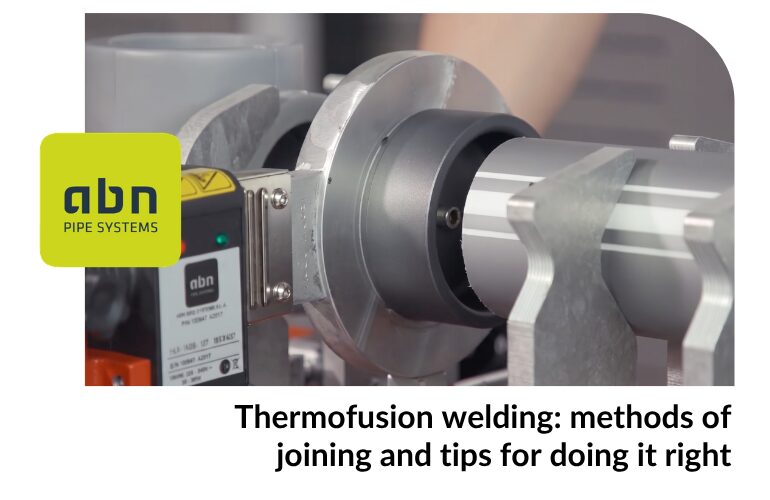
Thermofusion welding is the standard family of techniques used to join PPR pipes. It’s important to start with a key concept that is sometimes overlooked: Thermofusion is not a single procedure, but rather encompasses several joining methods, each with its own technique and steps. This article reviews the main methods and the key points for performing each one correctly.
Thermofusion joining methods
The term “Thermofusion” encompasses several techniques. The three most common are:
- Socket welding. The end of the pipe and the inside of the fitting are heated simultaneously using a tool (pipe fuser), and they are joined by inserting the pipe into the fitting. This is the most common method for small and medium diameters.
- Butt welding. The two ends to be joined are heated simultaneously against a heating plate and joined by placing them directly against each other, without any intermediate fitting. This method is used primarily for large diameters.
- Electrofusion. A fitting with a built-in electric heating element is used; when current flows through it, the element melts the material and forms the joint. This method is commonly used when precise control of the heat input is required.
Each method has its own procedure: confusing them or applying the steps from one to the other is one of the most common mistakes.
Key preparation tips
Some best practices are common to the various methods:
- Cut. Make a cut perpendicular to the axis of the tube. At the factory, we use a saw to ensure a clean, straight cut.
- Cleaning. Clean the pipe and fitting before joining them to remove any dust, grease, or debris that could compromise the joint.
- Marked. Mark the insertion depth to know how far to insert the component.
Surface scraping is a specific operation used in certain electrofusion processes; it is not a general step in socket or butt welding. Use it only when the electrofusion procedure requires it.
Cooking times and temperature
The quality of the joint depends on adhering to the heating times and the target temperature, which vary depending on the method and the diameter. An important detail in socket welding: the heating time begins when the component reaches the top of the tool, not before.
Since the times vary depending on the pipe diameter, it is best to always consult the time table corresponding to each diameter and each method, rather than applying a single value.
Cooking and Cooling
- Axial insertion (into a socket). Insert the component straight, in a straight line, without rotating it during heating or during the joining process.
- Cooling. Allow the joint to cool for the specified time before handling it. This time depends on the diameter, the method, and the working conditions; therefore, it is advisable to follow the relevant technical guidelines, distinguishing between cooling, handling, and pressure testing.
- Visual inspection. Check that the result is uniform throughout the joint.
An extra tip: female graft and male graft
Most of the market uses female connectors, which are the most common. There are also male connectors, which are less common but can be very useful in certain setups because they can save you from having to make additional connections. Understanding both options expands your possibilities when designing the installation.
Conclusion
A properly executed Thermofusion joint creates a reliable and durable connection, but the key is to correctly apply the appropriate method for each situation: socket, butt, or electrofusion, each with its own procedure. And if, for any project, you’d rather not handle these joints yourself, at ABN we manufacture custom collectors with all joints pre-assembled and tested in our workshop.