


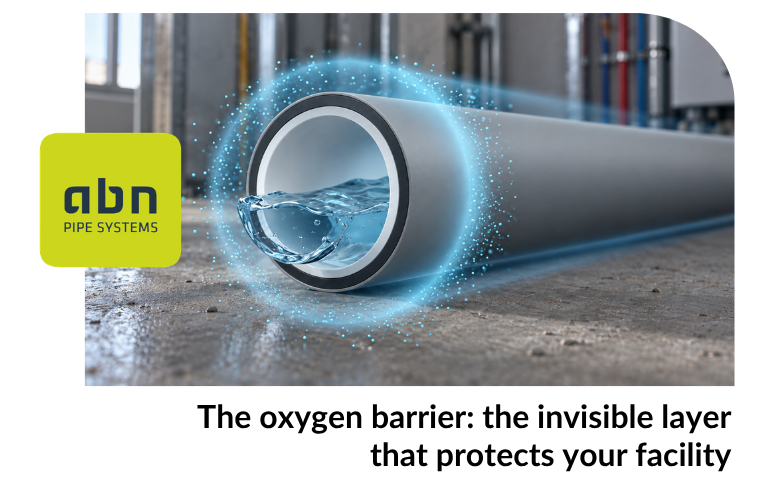
In a closed-loop heating or air conditioning system, there is one factor that can be overlooked when selecting piping: the ingress of oxygen into the water. An oxygen barrier helps limit this diffusion through the pipe wall and helps protect the metal components connected to the system.
The term “invisible layer” describes a feature that is not visible to the naked eye. In the case of ABN INSU PLUS, the oxygen barrier is an integral part of the inner pipe. It is not an additional EVOH or aluminum foil layer that must be removed before joining the pipe.
What Does Oxygen Do in a Facility?
Plastic pipes may exhibit some permeability to gases. Under certain conditions, oxygen molecules can diffuse from the outside into the pipe. Permeability depends, among other factors, on operating conditions such as temperature and pressure.
In a closed system, water circulates through a circuit that may include metal components, such as pumps, valves, boilers, heat exchangers, or emitters. The presence of oxygen can promote corrosion in these components. Over time, oxidation products and sludge may also form, affecting the system’s operation.
Actual performance depends on the design, materials, water, and operating and maintenance conditions. Therefore, the oxygen barrier is considered a protective measure for the system, not a standalone guarantee of the entire installation’s lifespan.
A barrier built into the pipe
The inner pipe of ABN INSU PLUS incorporates an oxygen barrier feature as part of its manufacturing process. Its function is to reduce the diffusion of oxygen through the pipe wall and thus limit its entry into the water in the circuit.
In this system, the barrier is not created by adding a layer of EVOH or aluminum that must be removed to make the joint. This allows the pipe to be worked on without that specific peeling step. The joint and its preparation must always be made in accordance with the system’s technical instructions and the appropriate procedure for each diameter and type of welding.
This feature is built into the product as it arrives at the facility. It is not a treatment applied afterward, nor is it a step that must be added during assembly.
What does it offer in practice?
By limiting oxygen ingress, the barrier can help reduce one of the factors that promote corrosion of the circuit’s metal components. This is particularly relevant in heating and air conditioning systems where water recirculates and comes into contact with pumps, valves, boilers, heat exchangers, and radiators.
This protection is not a substitute for proper sizing, water treatment when necessary, or scheduled maintenance of the system. It is part of the piping selection process: a technical decision that should be evaluated in conjunction with the system conditions and project requirements.
At ABN, the oxygen barrier performance of the ABN//INSTAL CT FASER RD pipe has been evaluated through permeability tests in accordance with DIN 4726. For test results and conditions, please refer to the technical data sheet and the documentation applicable to the specific product.
What to Look for When Choosing Pipe
Not all pipes use the same solution to prevent oxygen diffusion. When comparing options, review the technical data sheet and check the following:
- If the product claims to provide an oxygen barrier.
- What is the structure of the pipe, and does it include additional layers?
- What preparation is required of the system to make the joints?
- What test results and test conditions does the manufacturer report?
- Whether the solution is appropriate for the intended use in the project.
The technical data sheet allows you to compare specific information, rather than relying solely on the brand name or a general description. If you have any questions, the technical team can help you review the information relevant to your installation.
Discuss your project with ABN
At ABN Pipe Systems, we manufacture the ABN INSU PLUS system, its fittings, and custom Collectors in Spain. If you are designing a heating or air conditioning system, we can review the project documentation and requirements with you.
Call us at 981 148 425 or email us at info@grupoabn.com. You can also send us the floor plan or any available technical information so we can review your case.
