


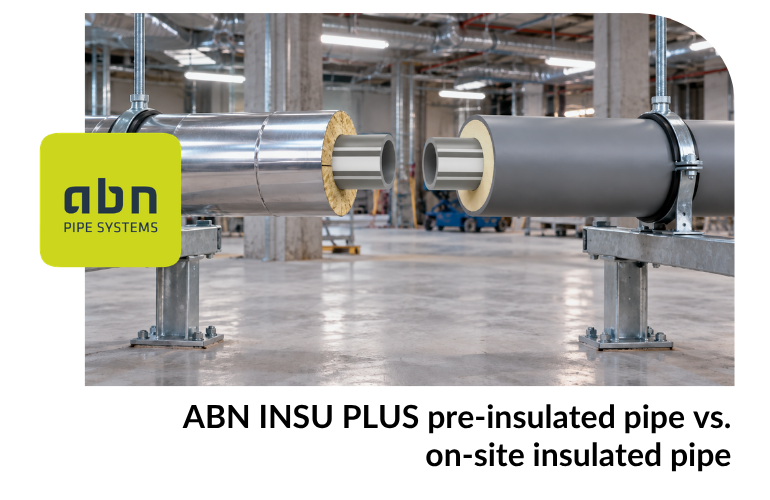
Two Ways to Meet the Same Requirement
When a project requires thermal insulation for a piping system, there are several ways to address it. With a conventional approach, the piping is installed first, and the insulation is applied at a later stage. Depending on how the project is organized, this task may be handled by another crew or by a company that specializes in thermal insulation.
With ABN INSU PLUS pre-insulated piping, insulation and exterior protection are integrated at the factory. This allows the installation team to work with a pre-insulated system from the start and plan the installation without having to rely on a subsequent phase to insulate each section. Connections, joint treatment, and the installation of fittings must be carried out in accordance with the system’s technical instructions and as specified in the project.
The difference, therefore, does not lie in the final requirement, but rather in the sequence of tasks necessary to meet it and how it is coordinated within the construction schedule.
What Does Insulation Installation on a Construction Site Involve?
Insulation is a phase of the installation process that requires materials, labor, and planning. Before beginning, you must coordinate its execution with the installation of pipes and other work being carried out in the same area. If a separate specialized team is involved, you must also factor their availability into the overall schedule.
Insulation is applied section by section and requires special attention at joints, changes in direction, branches, valves, and other fittings. The solution must be tailored to the project conditions, the type of fluid, and the specified insulation requirements. When tasks are divided among several teams, the coordination of deliveries and access can influence the order of execution.
This does not mean that on-site insulation is an inappropriate solution. It is a common method and may be suitable depending on the type of installation, its conditions, and the resources available. The important thing is to take it into account from the planning stage, rather than treating it as a secondary task that can be added without affecting the rest of the work.
What’s New with ABN INSU PLUS
ABN INSU PLUS is a pre-insulated system: the insulation and outer jacket are incorporated during manufacturing, before the piping arrives on site. The product configuration depends on the selected variant and the project requirements.
When receiving pre-insulated sections, the installation team can focus on assembling the system without having to apply insulation to each section afterward. Compatible pre-insulated fittings available for the system can also be specified. The selection process should take into account, from the outset, the elbows, branches, connections, and special points required by the layout.
On-site, layout, installation, proper execution of joints, and the required inspections remain essential. It is also necessary to follow the technical specifications for joints and terminations. For this reason, it is advisable to review the entire layout rather than simply comparing the price per meter of pipe.
Fewer follow-up procedures and more straightforward planning
Incorporating factory-installed insulation can reduce subsequent on-site work and simplify the coordination of that phase. The team can plan for the delivery and installation of the pre-insulated system as part of the overall project sequence, with less reliance on a separate insulation phase.
The impact on the timeline will depend on each project: length, diameters, fittings, accessibility, equipment availability, and coordination with other trades. The same applies to cost. To compare the two alternatives fairly, it is important to evaluate all the necessary materials and labor, including insulation, its installation, fittings, and the treatment of joints.
In projects with tight schedules, relying more heavily on a factory-ready solution can help make planning more predictable. It does not eliminate the need to coordinate installation, but it does allow you to address from the outset how the pre-insulated sections and fittings will be received and assembled.
What to Compare Before Making a Decision
To determine whether pre-insulated piping is right for your project, prepare the layout and compare both solutions under the same conditions. Check the following:
- The lengths, diameters, and route of the installation.
- The right outer shirt for the environment.
- The number and type of fittings needed.
- Labor to install the piping and apply insulation on site.
- The sequence of tasks and the availability of equipment.
- Instructions for performing joints, connections, and finishes.
- The total cost of each solution, not just the price of the tube.
A preliminary review helps identify which parts of the insulation are delivered pre-installed and which steps still need to be completed on-site. It also makes it easier to order the correct fittings and plan the installation with all the necessary information.
Talk to ABN
At ABN Pipe Systems, we manufacture the ABN INSU PLUS system, its fittings, and custom collectors in Spain. If you are considering an installation, we can review the blueprint, layout, and planned configuration with you to determine the best solution.
Call us at 981 148 425 or email us at info@grupoabn.com. Send us the available information about the project, and we’ll advise you based on the blueprint.
