


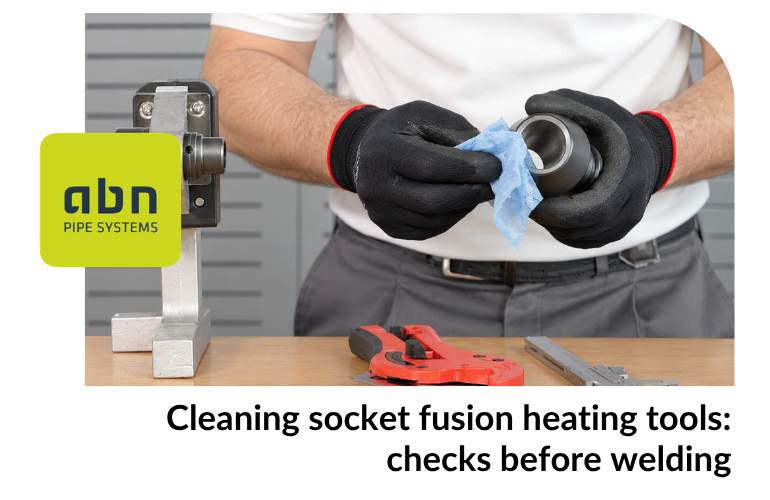
Cleaning socket fusion heating tools is a basic check before making a socket fusion joint. These tools transfer heat to the pipe and fitting, so their condition affects preparation of the surfaces to be joined.
Inspecting them before work and between operations helps identify residue or damage. Cleaning must follow the instructions provided by the equipment and heating-tool manufacturer.
In this article
- 1. Cleaning socket fusion heating tools: initial inspection
- 2. Use the cleaning materials specified by the manufacturer
- 3. Protect the non-stick coating
- 4. Stop if residue persists or damage is visible
- 5. Include inspection in work preparation
- 6. Distinguishing contamination from coating damage
- 7. Preparing the next joint without contaminating the tool
- Frequently asked questions
1. Cleaning socket fusion heating tools: initial inspection
Check that the tools match the pipe size and that their surfaces are clean. Material left from an earlier operation can contaminate the next joint or interfere with contact between the tool, pipe and fitting.
Inspection does not replace temperature control or compliance with fusion timings. It is part of preparing the equipment before welding.
2. Use the cleaning materials specified by the manufacturer
Follow the approved procedure and use authorised cleaning materials. Where paper is specified, it should be fibre-free and lint-free so it does not leave residue on the surface.
If the instructions allow a cleaning product, check compatibility and conditions of use. Do not apply alcohol or other solvents to hot surfaces or near ignition sources.
3. Protect the non-stick coating
Avoid abrasive tools and cleaning methods that could scratch the coating. Damage can allow plastic to adhere to the tool and interfere with joint preparation.
A tool with damaged coating cannot be restored simply by extending the heating time. Replacement should follow the manufacturer’s criteria.
4. Stop if residue persists or damage is visible
If material cannot be removed using the approved method, or if scratches or deterioration are visible, inspect the equipment before continuing to use the tool.
Resolving the issue first avoids repeating an operation with a damaged surface. Visual inspection of heating tools and control of welding parameters are complementary checks.
5. Include inspection in work preparation
Before starting the joints, prepare and keep readily available:
- The heating tools.
- The cutting equipment.
- The system documentation.
- The heating, assembly and cooling times for the relevant pipe size.
Consult the ABN socket fusion manual and our guide to thermofusion joining methods.
6. Distinguishing contamination from coating damage
Cleaning socket fusion heating tools means removing residue without altering the surfaces that contact the material. If an irregularity remains after following the manufacturer’s cleaning procedure, avoid progressing to more aggressive tools. First establish whether it is adhered material or damage to the coating itself. The two conditions do not call for the same response.
Inspect the surfaces that contact the outside of the pipe and the inside of the fitting. A tool can look clean while still showing a scratch or a damaged area that needs assessment. Continued use should depend on its condition and the manufacturer’s instructions, rather than only on whether the heating machine reaches its operating temperature.
7. Preparing the next joint without contaminating the tool
Arrange a work area where tools and cleaning materials cannot pick up dust, cutting debris or other particles. Follow the handling and temperature conditions specified for the equipment and use the appropriate protection. Once inspected, avoid placing the contact surfaces on a surface that could contaminate them again before the next joint is made.
A useful routine is to inspect before starting, check again if material transfer is observed, and review the equipment at the end of the task. Where a heating tool needs replacement, confirm compatibility with both the diameter and the machine before continuing. Cleaning, inspection and timing are connected parts of preparing a socket fusion joint, rather than independent checks to complete only once.
Frequently asked questions
Resolve your questions before the next joint
ABN Pipe Systems manufactures in Spain and provides technical support from the design stage. Send us your operating conditions and project details so we can assess the solution.
Call +34 981 148 425 or email info@grupoabn.com.
