


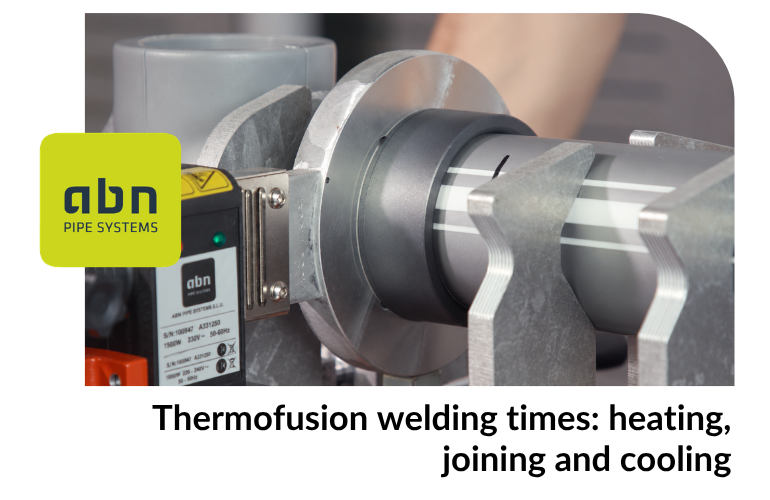
Thermofusion welding times are part of the joining procedure alongside temperature and pressure. Reaching the machine’s set temperature does not mean the pipe and fitting are ready to join: the timing specified for the system and method must also be followed.
Before starting, identify the material, diameter and pipe series or wall thickness. Socket fusion and butt fusion have their own procedures; their tables are not interchangeable.
1. Thermofusion welding times: the heating stage
Insufficient heating can prevent the joint from forming correctly. Excessive heating can deform the material and affect the result.
For socket fusion, the supplied table states that timing starts once the heating tool is fully inserted. Always check the application conditions and the instructions for the installed product range.
2. Joining: follow the procedure for the method
For socket fusion, the pipe and fitting are assembled in alignment, without twisting, within the specified time. Butt fusion also requires control of heater-plate removal and pressure application according to the procedure.
Do not transfer temperature settings or timings from one technique to another. Ambient conditions and equipment must also be considered before making the joint.
3. Cooling: a stage that must be completed
After assembly, keep the joint free from movement for the specified period. Shortening this stage to work faster can compromise the result.
Distinguish between cooling during assembly and total cooling time. Total cooling time should not be treated as automatic authorisation to pressurise the installation.
4. Procedure reference tables
The following tables reproduce the values in the document supplied for this guide. Before applying them, check the manual for the product, equipment and working conditions. Time ranges must not be reduced to a single setting without following the procedure.
Socket fusion
Guideline values for PP at an outdoor temperature of 20 °C and moderate wind. Heating time starts once the tool is fully inserted. A dash means that the supplied document gives no value for that combination.
| Diameter (mm) | Heating series 3.2 (s) | Heating series 5 (s) | Heating series 8 (s) | Assembly (s) | Cooling during assembly (s) | Total cooling (min) |
|---|---|---|---|---|---|---|
| 20 | 4 | 3 | – | 4 | 6 | 2 |
| 25 | 6 | 4 | – | 4 | 10 | 2 |
| 32 | 8 | 6 | – | 6 | 10 | 4 |
| 40 | – | 10 | – | 6 | 20 | 4 |
| 50 | – | 15 | – | 6 | 20 | 4 |
| 63 | – | 20 | 13 | 8 | 30 | 6 |
| 75 | – | 25 | 15 | 8 | 30 | 6 |
| 90 | – | 35 | 22 | 8 | 40 | 6 |
| 110 | – | 45 | 30 | 10 | 50 | 8 |
| 125 | – | 55 | 35 | 10 | 60 | 8 |
| 160 | – | 80 | 60 | 12 | 100 | 12 |
Butt fusion: series 5 / SDR 11
The source document attributes these parameters to DVS 2207-11 and specifies a heater temperature of 210 ± 10 °C. t1 is the time needed to form a bead of height h; the table does not give a fixed duration for t1.
| Diameter x wall thickness (mm) | Bead formation t1: height h (mm) | Heating t2 (s) | Heater removal t3 (s) | Pressure build-up t4 (s) | Cooling t5 (min) |
|---|---|---|---|---|---|
| 63 x 5.8 | 0.5 | 135-175 | 5-6 | 6-7 | 6-12 |
| 75 x 6.8 | 0.5 | 135-175 | 5-6 | 6-7 | 6-12 |
| 90 x 8.2 | 1.0 | 175-245 | 6-7 | 7-11 | 12-20 |
| 110 x 10 | 1.0 | 175-245 | 6-7 | 7-11 | 12-20 |
| 125 x 11.4 | 1.0 | 175-245 | 6-7 | 7-11 | 12-20 |
| 160 x 14.6 | 1.0 | 245-330 | 7-9 | 11-17 | 20-30 |
| 200 x 18.2 | 1.0 | 245-330 | 7-9 | 11-17 | 20-30 |
| 250 x 22.7 | 1.5 | 330-400 | 9-11 | 17-22 | 30-40 |
| 315 x 28.6 | 2.0 | 400-485 | 11-14 | 22-32 | 40-55 |
| 400 x 36.3 | 2.5 | 485-560 | 11-14 | 22-32 | 40-55 |
Butt fusion: series 8 / SDR 17
The source document attributes these parameters to DVS 2207-11 and specifies a heater temperature of 210 ± 10 °C. t1 is the time needed to form a bead of height h; the table does not give a fixed duration for t1.
| Diameter x wall thickness (mm) | Bead formation t1: height h (mm) | Heating t2 (s) | Heater removal t3 (s) | Pressure build-up t4 (s) | Cooling t5 (min) |
|---|---|---|---|---|---|
| 75 x 4.5 | 0.5 | 135 | 5 | 6 | 6 |
| 90 x 5.4 | 0.5 | 135-175 | 5-6 | 6-7 | 6-12 |
| 110 x 6.6 | 0.5 | 135-175 | 5-6 | 6-7 | 6-12 |
| 125 x 7.4 | 1.0 | 175-245 | 5-6 | 7-11 | 12-20 |
| 160 x 9.5 | 1.0 | 175-245 | 6-7 | 7-11 | 12-20 |
| 200 x 11.9 | 1.0 | 175-245 | 6-7 | 11-17 | 12-20 |
| 250 x 14.8 | 1.5 | 245-330 | 7-9 | 11-17 | 20-30 |
| 315 x 18.7 | 1.5 | 245-330 | 7-9 | 11-17 | 20-30 |
| 400 x 23.7 | 1.5 | 330-400 | 11-14 | 17-22 | 30-40 |
| 500 x 29.7 | 2.0 | 400-485 | 11-14 | 22-32 | 30-40 |
Consult the ABN socket fusion manual, the ABN butt fusion manual and the available technical documentation to confirm the procedure applicable to your installation.
5. Checks before starting
Before starting, check:
- The joining method and pipe identification.
- The condition of the equipment and heating tools.
- How the fusion timings will be monitored.
Resolve any uncertainty about a table entry or working conditions before welding.
For an overview of the techniques, read our guide to thermofusion joining methods.
6. Reading a table row without mixing up the units
First establish whether the joint uses socket or butt fusion. Then identify the diameter and pipe series or wall thickness specified for the product. Read each column with its own unit: seconds of heating or joining are different from minutes of total cooling.
Before applying thermofusion welding times to the equipment, verify the applicable manual and the conditions that accompany the table. If a value is missing, do not infer it from an adjacent row. Ask technical support to confirm the procedure and keep the relevant documentation available while the work is carried out.
Frequently asked questions
Ask ABN about the procedure for your pipe size
ABN Pipe Systems manufactures in Spain and provides technical support from the design stage. Send us your operating conditions and project details so we can assess the solution.
Call +34 981 148 425 or email info@grupoabn.com.
